 Fayad K. Hassan

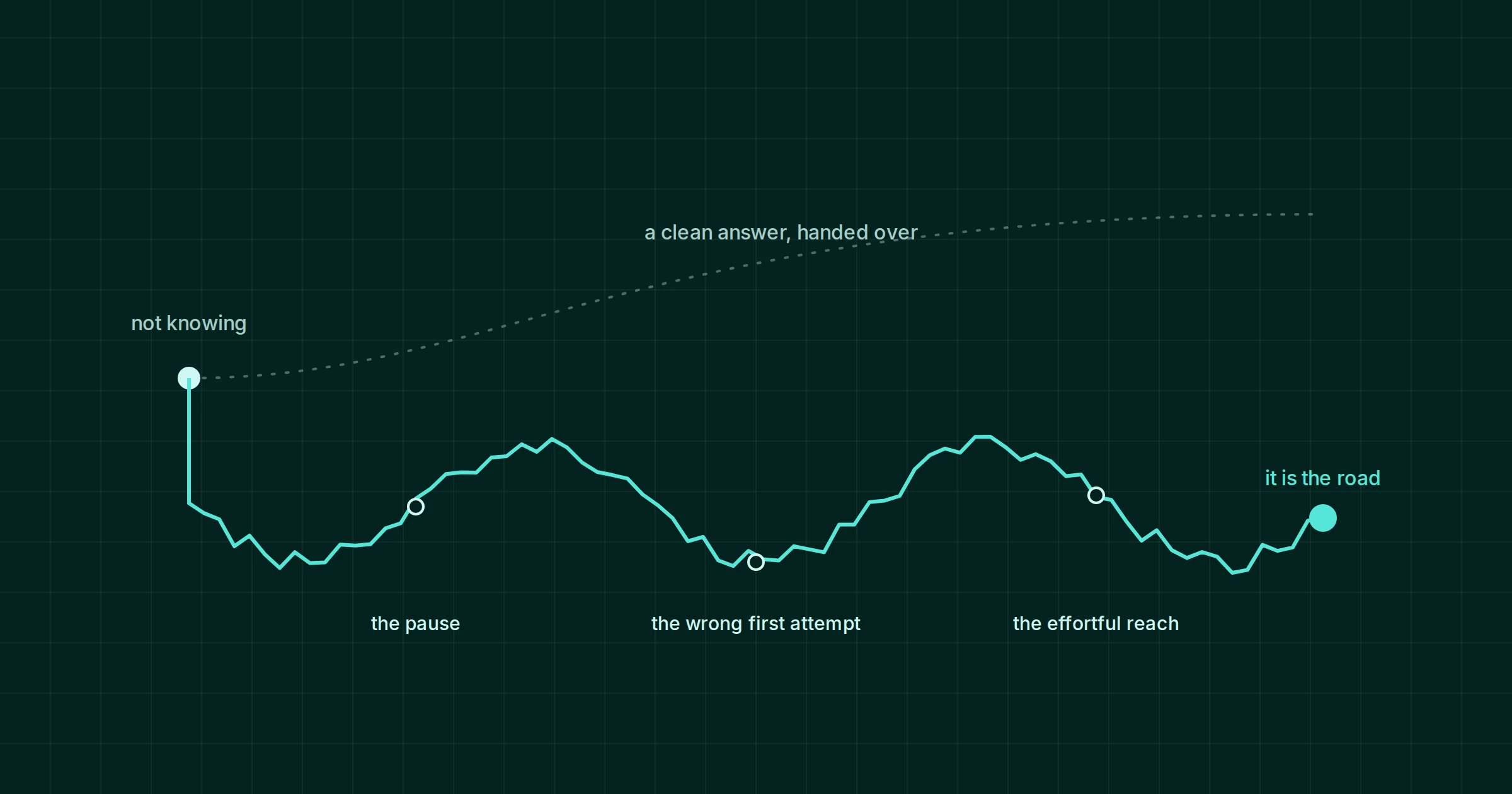
The usual case against AI in the classroom is that students will use it to cheat, or that it will feed them confident nonsense. Both happen, and both are manageable, and neither is the thing that worries me. The thing that worries me is that AI often works exactly as advertised. It hands you a clean answer and spares you the effort of arriving at one. That is the danger, not a side effect of it, and to see why you have to give up a comfortable assumption about how learning works.
The assumption is that effort is the price of learning, a cost you would remove if you could, like a long commute. Cut the friction, the thinking goes, and the learning arrives faster and cleaner. Fifty years of memory research says this is backwards. The effort is not the toll booth on the road to understanding. It is the road.
What the evidence shows
In 1978, Slamecka and Graf described the generation effect. People who generate a word themselves, even from a small prompt, remember it far better than people who simply read the same word handed to them complete. The act of producing it, with the small strain that involves, is what lays the memory down. Reading the finished answer feels like learning and mostly is not.
Robert Bjork built a career on the larger version of this, which he named desirable difficulties. Conditions that make practice feel harder and slower, spacing sessions apart, mixing problem types together, forcing yourself to recall a fact before checking it, produce worse performance in the moment and much better retention later. The reverse is the trap: study methods that feel smooth and fluent, like rereading your notes, produce a strong sense of mastery and weak actual memory. Fluency is a feeling. It is not knowledge, and the two come apart precisely when a tool makes everything feel easy.
Retrieval practice, the testing effect, is the same lesson from another angle. Trying to pull an answer out of your own head, and sometimes failing, teaches you more than being shown the answer again. The failure is not wasted. The reaching is the mechanism.
Now hold all of that next to a tool whose entire purpose is to deliver a finished, fluent answer the instant you feel the first flicker of not-knowing. It is engineered to abolish exactly the states that the research says do the teaching: the pause, the wrong first attempt, the effortful reach. It does not feel like a loss. It feels like help. That is what makes it hard to resist and worth being honest about.
The word “routine” is doing the damage
The optimistic pitch says: let AI handle the routine parts so the student is freed for higher-order thinking. I have come to distrust the word routine in that sentence, because it is smuggling the whole problem through.
For an expert, drafting a paragraph or grinding through an integral is genuinely routine, a solved skill on the way to something harder. For a learner, that same paragraph or that same integral is not routine. It is the rep. Automating it does not free the beginner for higher-order thinking. It removes the only path by which they would ever get there, because the higher-order skill is built out of thousands of the small struggles the tool just deleted. You cannot skip the reps and keep the muscle.
This is why “AI as a complement, not a replacement” is the right slogan attached to the wrong reasoning. Most people mean it as: use AI to remove the tedious parts and keep the interesting parts. For a learner that is precisely inverted. The tedious part often is the interesting part wearing work clothes.
What complement should mean
The version I would defend looks almost the opposite of the productivity pitch. Use AI to manufacture more friction, not less.
Let it generate the obvious, competent, average answer, then treat that as the floor you have to beat, not the work you get to hand in. Read it, feel where it is hollow or generic, and write the thing it could not. Ask it for three problems one step harder than the one you just solved. Have it play the examiner who keeps asking why until you hit the edge of what you actually understand. Make it produce the map of the consensus so you know exactly where to go off it. In every one of these, the strain stays with you, which is the only place it does any good.
I hold myself to this and I do not always manage it. The pull towards the clean answer is real, and pretending otherwise would be dishonest. But I know what it costs now, and naming the cost is what lets me sometimes pay attention instead.
There is a civic version of this worth stating plainly. If a generation learns to reach for the finished answer before the reach, the capacity to think through a hard problem unaided does not vanish evenly. It concentrates in the small number of people who kept doing the hard part, and everyone else becomes a customer of their output. That is not a story about education technology. It is a story about who gets to think, and it is decided one skipped struggle at a time, which is exactly why it is so easy to miss while it happens.
Sources
- Slamecka and Graf, on remembering what you produce yourself: the generation effect.
- Robert Bjork, on practice that feels harder and lasts longer: desirable difficulty.
 Fayad K. Hassan