 Fayad K. Hassan

The standard account of why people believe conspiracy theories was built to explain a specific patient: someone in a stable country with functioning institutions, a free-ish press, and public records, who nevertheless decides the moon landing was staged. In that setting the diagnosis makes sense. The belief is a failure of reasoning, a preference for a thrilling secret over a boring truth, and the cure is education, critical thinking, and media literacy.
I grew up around a different patient, and the imported prescription does not fit him. I am Sudanese. I have spent years doing open-source intelligence work on Sudan’s war. And the thing I keep running into is that a large share of what gets filed under “conspiracy theory” in Sudan was, or became, substantially true.
Start with the uncomfortable part
For years, ordinary Sudanese said that foreign powers were arming and funding the militias tearing the country apart, that the country’s gold was leaving through the Gulf, that men in the government were personally enriched by the very chaos they claimed to be fighting. In a seminar on media literacy, every one of those beliefs has the shape of a conspiracy theory: a hidden hand, foreign villains, elites secretly profiting.
They were also, in the main, correct. The flow of weapons to the Rapid Support Forces, the role of the United Arab Emirates, Sudanese gold moving into Dubai, the personal fortunes built on the war economy: these are now documented in United Nations panels, in investigative reporting, and in the country’s own decision to cut ties with a Gulf state it named as a backer of the militia. I have written about the mechanics of it elsewhere. My point here is not the specific charge sheet. It is what this does to the concept of a conspiracy theory.
If you had run a media-literacy campaign in Khartoum in 2019 teaching people to distrust “unverified claims of secret foreign interference,” you would have trained them, with the best intentions, to disbelieve something real. The tools we hand out to fight conspiracism, appeals to official sources, trust in institutions, scepticism towards the sensational claim, all quietly assume the official sources are honest and the sensational claim is the false one. Reverse that assumption, which Sudan’s history forces you to do, and the tools point the wrong way.
What is broken
So the psychology-of-belief framing, the version I wrote years ago that leaned on mistrust of authority and low education as if they were defects, misses the real mechanism. Mistrust of authority in Sudan is not a cognitive bias. It is an accurate memory. The state has lied about massacres its own forces committed. Institutions have collapsed in living memory, more than once. Distrust is what a rational person learns from that record.
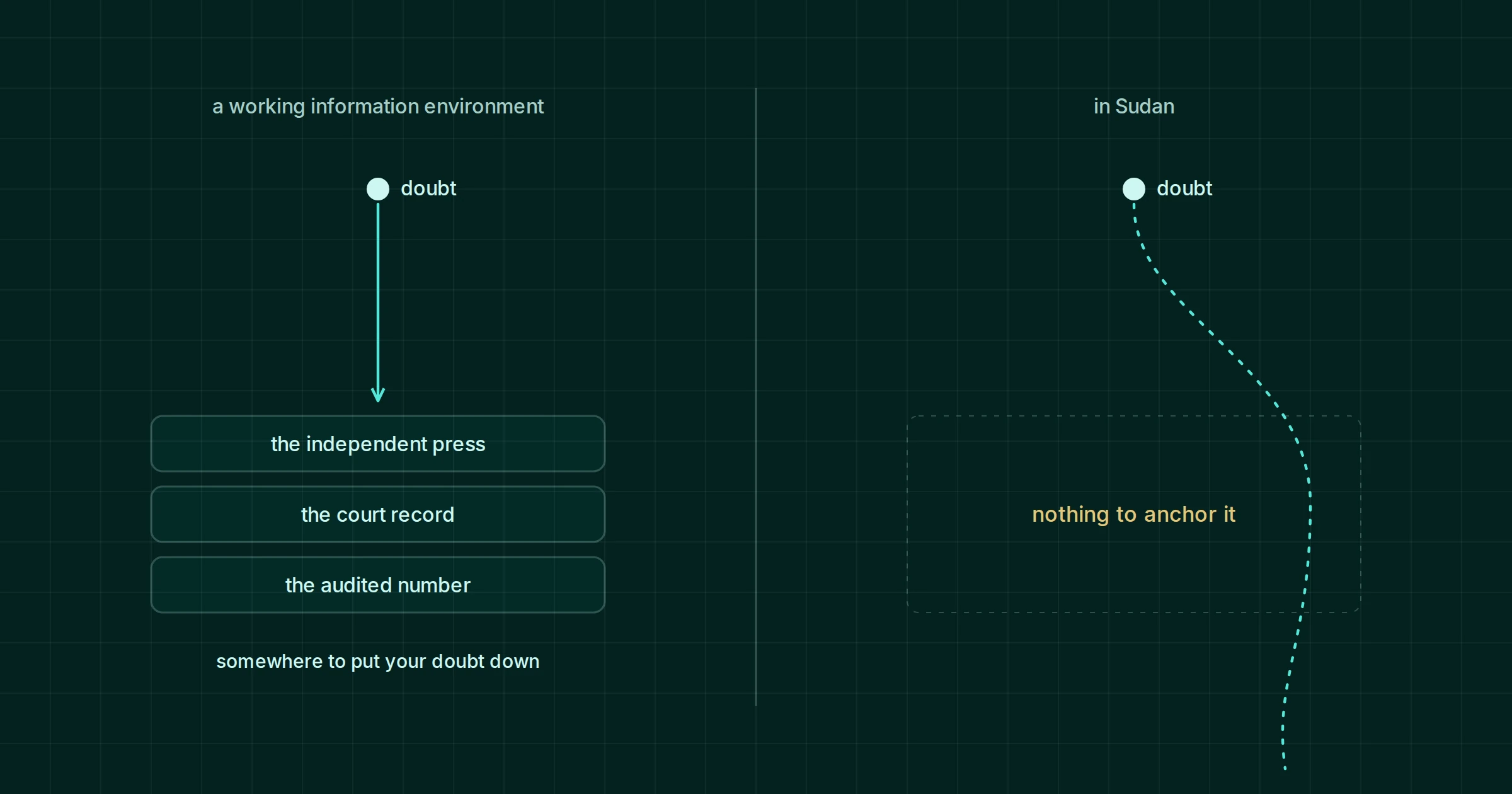
Here is the trap that distrust springs, and it is the actual problem worth naming. Healthy scepticism needs somewhere to land. In a working information environment, you stop believing the government and you go check the independent press, the court record, the audited number. You have somewhere to put your doubt down. In Sudan, and in a growing number of places, every one of those anchors has been captured, defunded, destroyed, or was never built. So the scepticism has nowhere to land. It just keeps going.
And scepticism with nothing to anchor it is indistinguishable, from the inside, from paranoia. Once you have correctly learned that the official story is often a lie, you have no reliable way left to sort the true hidden story from the false one, because the same instinct, “the real truth is being hidden from me,” fits both. The person who correctly believed the UAE was arming the RSF and the person who believes the war is a Masonic plot are running the identical algorithm. What separates them is not intelligence or education. It is whether a trustworthy verification mechanism happened to survive for the question they are asking. Usually one did not.
That is why higher education does not reliably help, and can make it worse. A more capable reasoner with no trustworthy inputs does not reach better conclusions. He builds more sophisticated and more convincing wrong ones, and he is harder to talk out of them, because he can out-argue you. I have watched genuinely brilliant people construct airtight cases on rotten foundations, and the intelligence was the accelerant, not the brake.
Why the usual cure fails, and what helps
Telling a Sudanese audience to “think more critically” is close to an insult, and it does not work, because the failure was never a shortage of critical thinking. Often it is a surplus of it aimed at a target with no solid ground beneath it. You cannot lecture someone out of distrust that they earned.
The thing that actually moves the needle, in my experience, is not an argument at all. It is verifiable evidence that a person can check for themselves without having to trust me, the government, or any institution. This is the whole reason I do open-source work the way I do it. When you geolocate a video to a specific rooftop from the shadows and the skyline, when you match a shipment to a flight record anyone can pull, when you lay the sources out so a stranger can walk the same path and arrive at the same place, you are not asking anyone to believe you. You are rebuilding, one checkable claim at a time, the thing the country lost: a shared method for establishing what is true that does not depend on trusting the people in charge.
That is slow, and it does not scale like a poster campaign, and it will not cure the person already committed to the Masonic plot. But it is the only response I have found that respects why the distrust exists instead of scolding it. The problem in Sudan was never that people believed in hidden hands. Sometimes the hand was right there in the record. The problem is that we have almost no trusted way left to tell the real hand from the imagined one, and you do not fix that with better citizens. You fix it by rebuilding, piece by verifiable piece, something worth trusting.
Sources
- My own account of the foreign hand in the war: The High Price of Ambition.
- Background on the conflict, its backers and the gold trade: the war in Sudan.
 Fayad K. Hassan