 Fayad K. Hassan

Key points
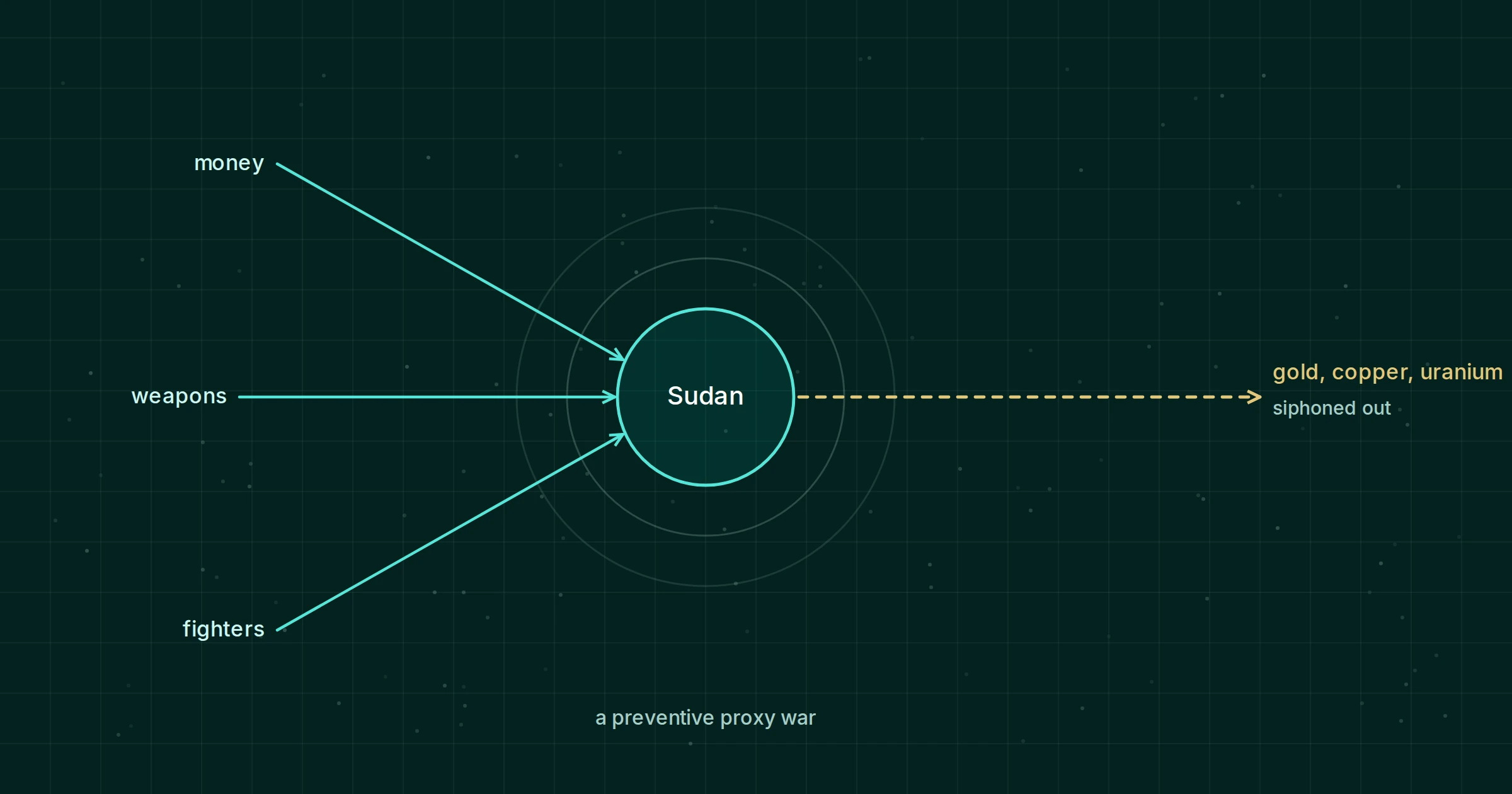
- Sudan’s war is also a “preventive proxy war”: regional powers, the UAE above all, shaping the conflict to protect their own interests.
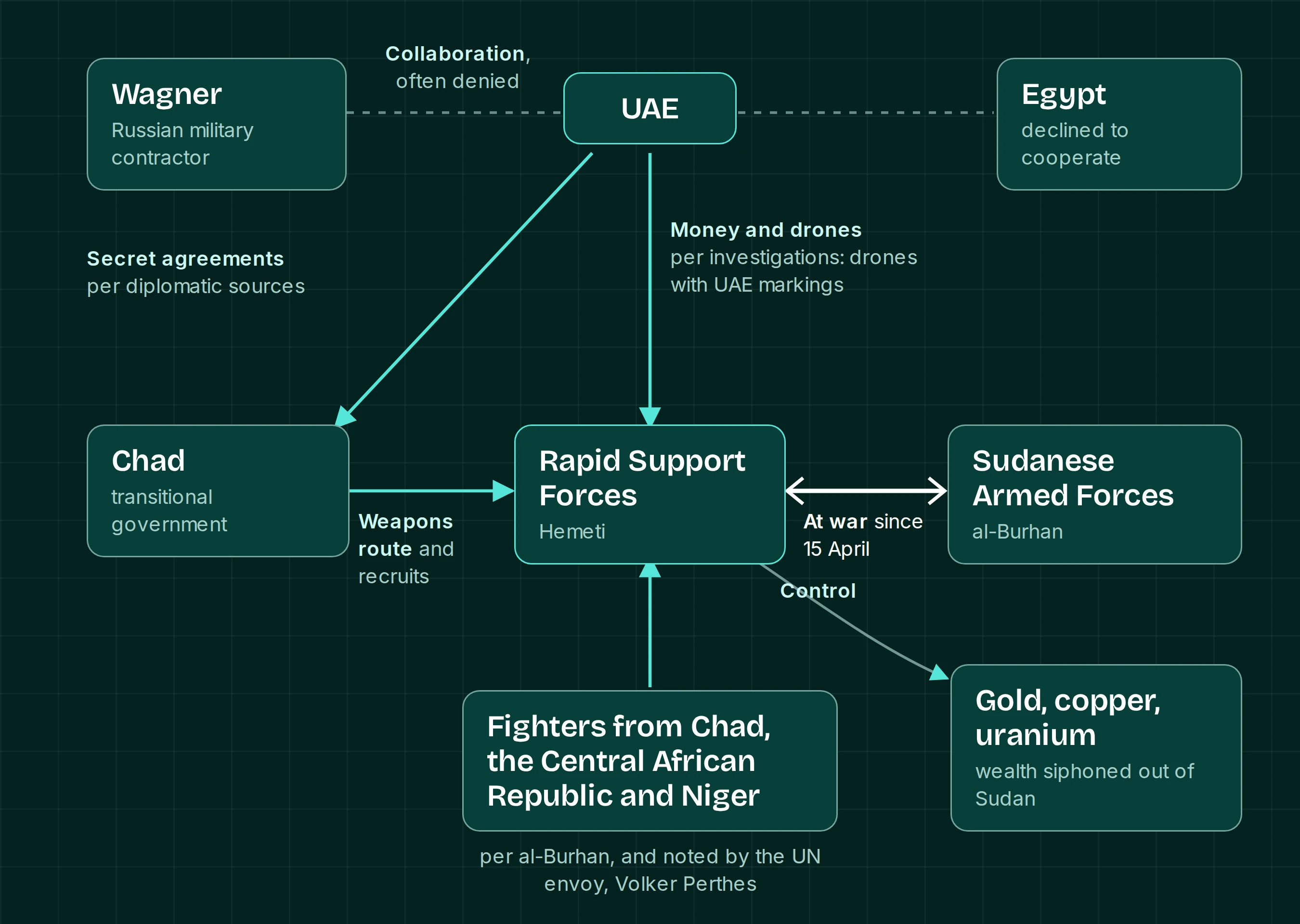
- Support for the RSF runs through Chad, with secret agreements, a weapons route and drones bearing UAE markings, as reported by diplomatic sources and investigators.
- Chadian recruits, many driven by poverty at home, serve in the RSF, which ties Sudan’s war to crises across the region.
In the heart of the African continent, Sudan is a nation struggling to stabilize itself amid ongoing turmoil. The conflict has resulted in the displacement of over 5.25 million individuals, which translates to one in every 10 Sudanese citizens, both within the country and beyond its borders, since hostilities erupted on 15 April. Among those affected are more than 1 million people who have sought refuge in neighbouring countries.
However, beneath the surface of its domestic challenges lies a tangled and unsettling reality: Sudan has become a battleground for regional powers engaged in a new form of proxy warfare, one that can be characterized as a “preventive proxy war”.
In 2013, the Rapid Support Forces (RSF), originally arising from the Janjaweed militia and subsequently receiving official state recognition, were assigned several roles. These included suppressing rebellious movements in Darfur, safeguarding border security, and combating smuggling operations.
A recent damning report from Human Rights Watch (HRW) has brought to light the RSF’s alleged complicity in the execution of numerous individuals and the complete devastation of a town in Sudan’s West Darfur state. This incident resulted in the loss of at least 87 lives, their bodies found in a mass grave, among them women and children. Mustafa Mohamed Ibrahim, an adviser to the RSF leadership, explained to the BBC that these clashes were part of an enduring civil conflict pitting Arab groups against the Masalit, a conflict rooted in a long and recurring history.
Shockingly, a few weeks ago, the West Darfur governor, who accused the RSF of perpetrating genocide against the Masalit people, was assassinated. The Masalit people, who once lived under a sultanate in West Darfur predominantly incorporated into Sudan over a century ago, predominantly adhere to the Islamic faith. They have consistently alleged that successive Sudanese governments have favoured “Arabism” at their expense, neglecting them in terms of fundamental services like education and healthcare. There are growing concerns that the RSF and Arab militias’ assaults on the Masalit community could lead to a tragic recurrence of the 2003 Darfur massacres, in which the Janjaweed militias, later transforming into the RSF, were responsible for the deaths of 300,000 individuals.
It has become evident, however, that the Janjaweed has transcended its original role as a mere militia, morphing into a racial instrument and tribal endeavor. The Arab tribes of Darfur, initially victims of regional power exploitation and structural policies that perpetuated poverty, now find themselves ensnared in this tangled conflict. Oversimplifying the situation as a mere tribal war perpetuates ethnic propaganda, obscuring the deeper issues intertwined with poverty, market economics, and the exploitation of gold resources.
Tensions and alignments in Sudan’s proxy war
Since the formation of the Sovereign Council in 2019, tensions between the army and the Rapid Support Forces (RSF) have been consistently visible. This situation emerged during the transitional phase following the ousting of President Omar al-Bashir from power. However, the discord reached new heights when the army dissolved the Sovereign Council and ousted Prime Minister Abdalla Hamdok’s transitional government on 25 October 2021, effectively seizing control.
Subsequently, both factions strategically aligned themselves with fragmented civil forces. Hemeti, in an effort to improve his public image following his association with Darfur under Omar al-Bashir’s regime and the June 2019 massacre at the General Command protest site in Khartoum, distanced himself from the coup of 25 October 2021. He positioned himself as a proponent of transitioning power to civilian forces. On the other hand, he accused General al-Burhan of attempting to co-opt loyalists from the previous regime, making this accusation publicly on 20 February 2023.
In response, General al-Burhan cautioned the RSF forces about their independent actions, separate from the army, and urged their swift integration. The issue of integration became a central factor leading to the escalation of the conflict. Hemeti subsequently sought closer alignment with political and civil forces, accommodating their demands within the negotiation workshops of the framework agreement. His primary objective was to build political support to counter General al-Burhan and the army’s leadership. These demands included a clause stipulating the army’s withdrawal from the political process and its commitment to a civilian government to be established in line with the framework agreement. However, General al-Burhan linked the army’s support to the agreement and the RSF’s integration, further exacerbating tensions.
The conflict reached a turning point when the RSF attempted to seize an army airbase in Marawi. This aggressive move destabilized Sudan and posed a direct threat to regional peace and security. The Sudanese Armed Forces expressed legitimate concerns about the RSF’s uncoordinated movements and deployments, which undermined the authority and unity of the armed forces.
In the midst of this tangled conflict with heavy external involvement, Sudan faces a critical challenge. The underlying power struggles, the influence of outside support and the threat to stability all need to be brought into the open. This report sets out the actors involved, their vested interests, and what they mean for Sudan’s future. By uncovering these realities, we aim to encourage international cooperation and effective solutions that support Sudan’s stability and democratic transition.
Oversimplifying the situation as a mere tribal war perpetuates ethnic propaganda, obscuring the deeper issues intertwined with poverty, market economics, and the exploitation of gold resources.
The UAE’s involvement: motives and consequences
The United Arab Emirates (UAE) has become a major player in Sudan’s tangled conflict, driven by a combination of anti-political Islam agendas and its pursuit of economic interests. This involvement has wide-ranging consequences for Sudan and for the entire region. Examining the UAE’s actions and motivations is essential to understanding their impact on Sudan’s stability, regional dynamics, and diplomatic relations in the future.
The UAE’s engagement in Sudan goes beyond financial support, encompassing political manoeuvring and agreements with neighbouring countries to advance its interests. Notably, the UAE’s support for the Rapid Support Forces (RSF) and their military equipment needs led to partnerships with Chad after Egypt declined to cooperate. This demonstrates the UAE’s willingness to prolong the Sudanese conflict, contributing to ongoing chaos in the region. The UAE’s alignment with key U.S. foreign policy objectives has allowed it to evade scrutiny compared to Russia’s intervention in Sudan. Lieutenant General Abdel Fattah al-Burhan, Commander in Chief and archenemy of Hemeti, has revealed the presence of mercenaries from Chad, the Central African Republic, and Niger fighting alongside the RSF militia. The involvement of these mercenaries, acknowledged by the United Nations envoy to Sudan, Volker Perthes, should not be underestimated.
Concrete evidence also points to the UAE’s direct interference in Sudan’s internal affairs. Diplomatic sources have disclosed the UAE’s efforts to support RSF rebel forces through secret agreements with Chad’s transitional president, Mohammed Idriss Déby Itno, coupled with financial incentives. These agreements aimed to exploit Chad’s proximity to Sudan for smuggling weapons and military equipment to the RSF.
Investigations have uncovered the UAE’s provision of drones to the RSF, with downed drones bearing UAE markings and ammunition linked to the Serbian company “Yugoimport.” Similar drones have been discovered in other conflict zones, implicating Abu Dhabi in their supply, including in Yemen and Ethiopia. In light of these revelations, it is evident that the UAE’s involvement in Sudan’s conflict has serious implications for regional stability and global geopolitics. Addressing this interference requires international cooperation and concerted efforts to promote Sudan’s democratic transition and long-term stability.
Preventive proxy war, defined
In Sudan’s conflict, the term “preventive proxy war” has a specific and deeply consequential meaning. It refers to a strategic paradigm in which regional powers, such as the United Arab Emirates (UAE), are actively shaping and influencing the trajectory of Sudan’s turmoil to safeguard their own interests and geopolitical agendas.
This proactive proxy warfare strategy works on several fronts at once:
-
Resource Plundering: Regional powers like the UAE are driven by economic interests, particularly the exploitation of Sudan’s valuable resources, including gold, copper, and uranium. Financial support provided to groups like the Rapid Support Forces (RSF) serves to strengthen control over these resources, even as a large portion of the wealth generated is illicitly siphoned out of Sudan, further deepening the country’s economic woes.
-
Influence and Regional Power Dynamics: Preventive proxy war means using regional influence to shape outcomes in Sudan. By strategically supporting specific factions and paramilitary groups, regional powers aim to assert control over Sudan’s internal affairs and exert influence over its politics.
-
Global Capitalist Ideologies: The engagement of regional powers in Sudan’s conflict aligns with global capitalist ideologies, emphasizing neoliberalism and free-market principles. These powers use economic incentives and partnerships to advance their interests while influencing the broader economic and political dynamics within Sudan.
-
Geostrategic Manoeuvring: Preventive proxy war extends beyond Sudan’s borders as regional powers collaborate with external actors, like Russian military contractor Wagner. This collaboration, while often denied, carries real weight for regional stability and international geopolitics, including circumvention of economic sanctions. In essence, the concept of “preventive proxy war” captures the proactive efforts of regional powers, on all of these fronts, to shape Sudan’s conflict in their favour, safeguard their economic interests, and exert influence over the country’s future. Understanding this term is key to understanding the tangled dynamics at play in Sudan’s ongoing turmoil.
Foreign fighters: the Chadian connection
In Sudan’s ongoing conflict, a central aspect revolves around the involvement of Chadian opposition members within the Rapid Support Forces (RSF) and the potential implications for regional stability. This involvement, while entwined with economic and social factors, raises questions about foreign recruitment and its impact on the already precarious situation in Sudan.
Chadian opposition and RSF involvement
Prominent members of the Chadian opposition, such as Al-Razaiki and Capt Habib Ali Hareka, have found roles within the RSF. Others have joined the RSF individually, separate from their former organisations. This cross-border recruitment has seen Chadian recruits participating in Sudan’s internal conflicts, particularly within the RSF.
Estimates of Chadian recruits
Estimates regarding the number of Chadian recruits within the RSF vary. Al-Razaiki believes that tens of thousands of Chadian recruits have joined the RSF since its inception in 2013, while Abdullah Al-Tahir puts the number at around 7,000. Researcher Jérôme Tubiana suggests that the higher estimate may be closer to reality, citing data from 2013 to 2017 that included Arabs and non-Arab tribes, like the Tama.
Expanding geopolitical consequences
The cross-border recruitment by Sudanese militias, including the RSF, has broader implications. It reflects a willingness to engage in external conflicts, with Chadian RSF recruits being deployed in the Yemen war. Their reputation for discipline and ability to execute orders makes them sought after, further complicating the regional dynamics.
Economic factors driving recruitment
A major driving force behind Chadian recruitment in foreign militias is the extreme poverty in Chad. Statistics reveal high poverty rates and severe deprivation among the population. This dire economic situation compels many Chadians to seek work abroad, including joining armed groups in neighbouring countries.
Legal restrictions and recruitment challenges
Chadian law prohibits nationals from enlisting in foreign forces and criminalizes mercenary activity. However, practical challenges hinder the state’s ability to prevent such recruitment, given the ongoing destabilization in Chad.
The involvement of Chadian recruits within the RSF adds another layer to Sudan’s conflict. It highlights the interconnectedness of regional crises, economic vulnerabilities, and the many causes behind foreign recruitment in conflict zones. Addressing these dynamics requires a full understanding of the underlying factors and their impact on Sudan and the broader region.
UAE-Sudan relations: interests and influence
The enduring relationship between the United Arab Emirates (UAE) and Sudan has evolved over decades, marked by shared cultural, economic, and political exchanges. From supporting Sudan’s quest for self-rule during its early independence to the current era of economic collaboration and strategic engagement, the dynamics of UAE-Sudan relations have witnessed notable transformations.
Countering political Islam and regional stability
A central factor behind the UAE’s influence in Sudan is its commitment to countering political Islam and promoting regional stability. Historically governed by Islamist-leaning administrations, Sudan has grappled with political turbulence and internal strife. The UAE, driven by its aversion to political Islam, sees an opportunity to exert its influence and shape Sudan’s political direction.
Economic investments
The UAE has emerged as a significant investor in Sudan, with a particular focus on sectors like agriculture, infrastructure, and real estate. Sudan’s developmental history, marked by underdevelopment and imbalanced modernization, has paved the way for UAE investments to capitalize on the country’s vast agricultural potential.
Osama Dawood Abdellatif and the DAL Group
Notably, Sudanese businessman Osama Dawood Abdellatif, a key figure in the Dal Group, has played a substantial role in various economic sectors, including agriculture and logistics, contributing to Sudan’s economy. However, concerns linger regarding the potential exacerbation of economic disparities and their contribution to Sudan’s ongoing conflict.
Sheikh Tahnoon’s involvement
In October 2020, Sheikh Tahnoon bin Zayed Al Nahyan’s IHC Food Holding LLC entered into a joint agreement with the DAL Group to develop farmland in Sudan, solidifying Sheikh Tahnoon’s economic role in the country. This collaboration highlights the close relationship between Sheikh Tahnoon and Osama Dawood Abdellatif and their shared interests in Sudan’s economic progress.
Infrastructure development and concerns
The UAE, in conjunction with Invictus Investments and AD Ports Group, has initiated a major infrastructure project in Sudan, aiming to create a mega-port and container terminal. This venture raises concerns about its potential implications for Sudan’s stability and economic disparities.
Controversial involvement and legal actions
Leaked documents have revealed the UAE’s involvement in recruiting mercenaries for deployment in various conflict zones, including Libya and Sudan. Sheikh Tahnoon’s IHC is implicated in this network, sparking concerns about human trafficking and violations of international law. Legal actions have been initiated against the IHC, seeking accountability for its role in escalating conflicts.
As UAE-Sudan relations continue to evolve, these tangled dynamics encompassing economic interests, strategic manoeuvres, and controversies warrant vigilant monitoring to ensure transparency, accountability, and a balanced approach to building stability and development in Sudan and the broader region.
Implications for regional stability
The tangle of geopolitical relationships, economic ventures, and controversies surrounding the United Arab Emirates (UAE) and Sudan’s interactions carries lasting implications for regional stability. As these dynamics continue to unfold, several key considerations emerge:
-
Regional Geopolitical Realignment: The UAE’s efforts to counter political Islam and shape Sudan’s politics represent a broader realignment of regional alliances. This realignment may contribute to shifting power dynamics and alliances among Middle Eastern and African nations.
-
Economic Dominance and Disparities: UAE investments in Sudan, particularly in agriculture and infrastructure, hold the potential to exacerbate existing economic disparities within the country. Such disparities can be a source of social unrest and instability, in Sudan and in neighbouring regions.
-
Resource Exploitation and Conflict: The UAE’s economic interests in Sudan’s abundant resources, including agricultural land and minerals, raise concerns about resource exploitation. Competition for these resources may escalate conflicts, further destabilizing the region.
-
Human Trafficking and Violations: The involvement of high-ranking UAE officials and their business affiliations in recruiting mercenaries for conflicts in Sudan and Libya has raised serious human rights concerns. These actions may lead to international condemnation and calls for accountability.
-
Potential for Regional Escalation: Regional stability could be at risk if conflicts in Sudan escalate or spill over into neighbouring countries. The involvement of foreign mercenaries and the UAE’s strategic interests may inadvertently exacerbate regional tensions.
In light of these implications, it is imperative for international actors and regional stakeholders to closely monitor developments in UAE-Sudan relations. Regional stability hinges on addressing these tangled factors and building cooperation to mitigate potential conflicts and instability in the broader Middle East and Africa.
Sudan’s proxy war, with its unique “preventive” twist, shows the complexity of modern conflicts. It reveals how external actors exploit the vulnerabilities of a nation in turmoil, and it serves as a stark reminder that Sudanese politicians bear the responsibility of safeguarding their nation’s interests in the face of regional power games. The path to peace and stability in Sudan requires not only international mediation but, most importantly, Sudanese agency and political wisdom to steer through these treacherous waters.
Sources
- Background on the war and its regional backers: the war in Sudan.
- A later piece on what the same bet cost the UAE: The High Price of Ambition.
 Fayad K. Hassan