 Fayad K. Hassan

The allure of proxy power
Sudan has been engulfed in a devastating civil war since 15 April 2023, pitting the Sudanese Armed Forces (SAF) against the paramilitary Rapid Support Forces (RSF). This conflict, born out of a power struggle between former allies General Abdel Fattah al-Burhan (SAF) and General Mohamed Hamdan Dagalo, known as Hemeti (RSF), has plunged the nation into a deep humanitarian crisis, displacing millions and claiming tens of thousands of lives. The United Arab Emirates (UAE) initially viewed this unfolding conflict with a degree of confidence, particularly given the early momentum and mobility of the RSF. For Abu Dhabi, Sudan was perceived as a strategically ‘winnable’ theatre, offering significant geopolitical and economic advantages. The UAE’s interest was underpinned by Sudan’s geographical position, providing access routes through neighbouring Chad, Libya, and South Sudan, as well as key air corridors. Pre-war engagements, including the recruitment of SAF officers and covert influence operations, also suggested the ground was favourable for the UAE’s regional ambitions.
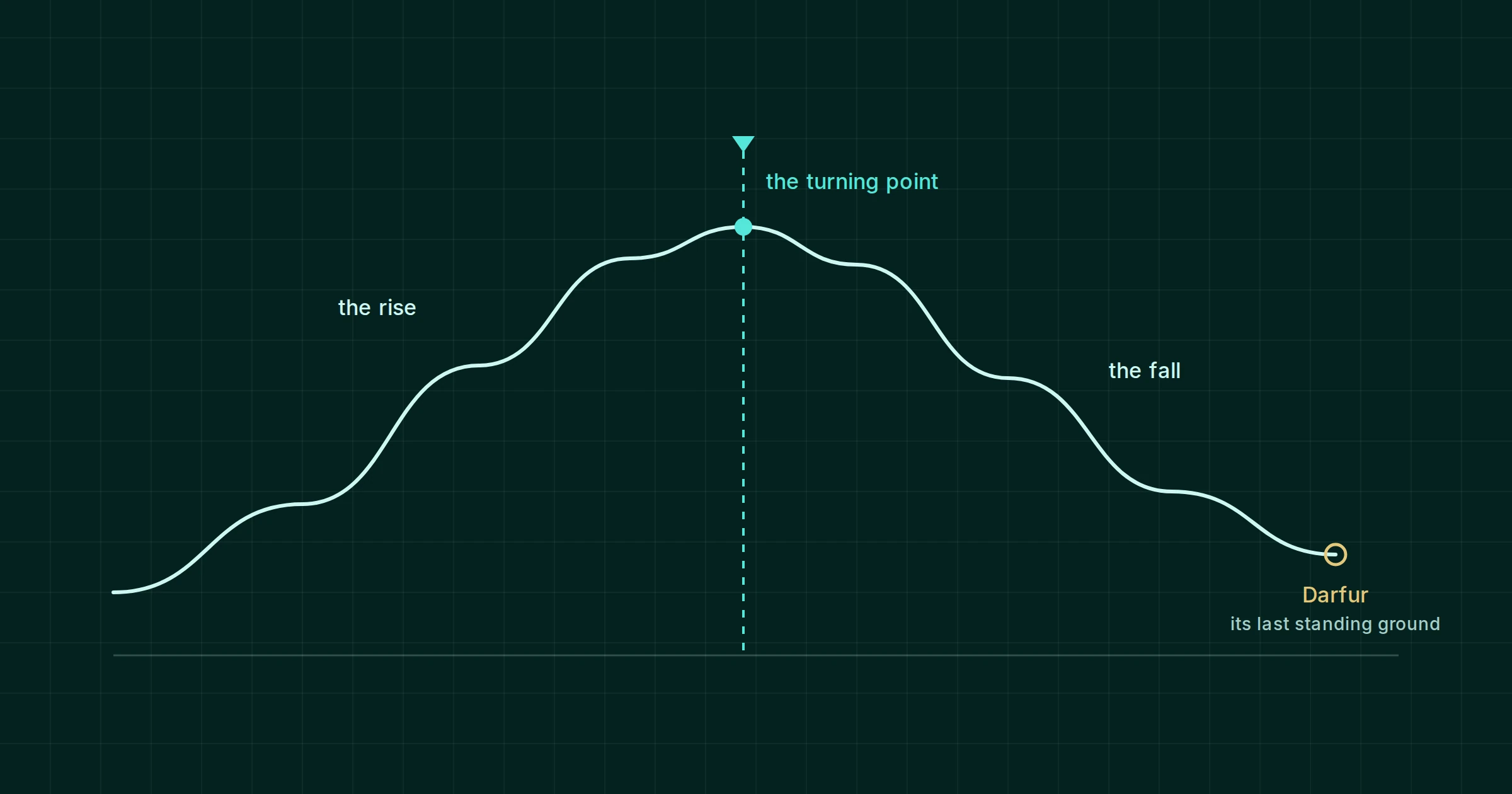
The rise: momentum, access and early wins
In the initial phases of the conflict, the RSF demonstrated remarkable agility and territorial gains, feeding a rising confidence within the UAE regarding its strategic investments. This overconfidence, perhaps fuelled by perceived successes in other theatres like Tripoli, Libya, where the UAE had backed Khalifa Haftar and his Libyan National Army (LNA) alongside Russian Wagner Group mercenaries, led Abu Dhabi to double down on its support for the RSF. The illusion of a quick victory, relying heavily on the RSF’s speed and mobility, overshadowed the critical need for statecraft and long-term governance. This initial dominance was significantly bolstered by the strategic advantages Sudan offered, particularly its access routes. The UAE used its influence in neighbouring countries like Chad and Libya to facilitate logistical support and arms transfers to the RSF, often under the guise of humanitarian aid, despite international allegations and denials. Crucially, Sudanese gold exports, largely controlled by RSF-linked companies, flowed into Dubai, enriching the UAE’s private sector and further cementing Abu Dhabi’s calculations regarding the profitability of its involvement. The RSF’s agility, honed through years of operating as a paramilitary force, allowed them to exploit the SAF’s more conventional and slower operational tempo. This, combined with the UAE’s ‘backyard theory’, a geopolitical doctrine aiming to control influence across a contiguous zone from Libya to South Sudan, positioned Sudan as a critical piece in Abu Dhabi’s broader regional strategy. The prospect of controlling key trade routes, agricultural lands, and gold mines, particularly those already under RSF influence, presented a compelling incentive for the UAE’s deep engagement.
The fall: overreach, missteps and resistance
Despite initial successes, the RSF’s campaign began to falter, revealing serious strategic miscalculations and a lack of coherent ground strategy. The UAE’s backing, while substantial in terms of resources, could not compensate for the RSF’s inherent weaknesses. A critical misstep was the RSF’s scattered positioning and unsustainable territorial control. Rather than consolidating gains, their rapid expansion led to overextension, leaving their forces vulnerable and their control tenuous across vast swathes of Sudan. This overreach was met by the Sudanese Armed Forces’ (SAF) unexpected patience and calculated strategy, employing asymmetric resistance. The SAF effectively used its understanding of the local geography, launching targeted airstrikes and drawing on its familiarity with urban environments to inflict heavy losses on the RSF. While the RSF fought everywhere, they ruled nowhere, demonstrating a critical fragmentation of control. This tactical patience let the SAF regain ground steadily and grind down the overstretched RSF. Both the UAE and the RSF also badly misjudged the tangled Sudanese political dynamics. The conflict was not merely a military contest but was deeply intertwined with civilian and political actors, whose divisions and allegiances were far more complicated than initially perceived. The RSF’s heavy-handed approach and disregard for civilian populations alienated potential allies and fuelled widespread resistance, even among those who initially harboured grievances against the SAF. This failure to understand and read the tangled local politics proved to be a serious obstacle to the RSF’s ability to convert battlefield gains into lasting control, ultimately contributing to their strategic decline. The SAF’s deep-state resilience, rooted in established institutions like the judiciary, banks, and traditional tribal structures, proved far sturdier than the RSF’s nascent attempts at governance, which they could not replace.
Ignorance of complexity: the human factor
The RSF’s ambition to occupy Sudan, rather than merely influence it, proved to be a critical miscalculation, akin to biting off more than they could chew. While the UAE’s financial and military backing provided seemingly endless supplies, the fundamental challenge of enforcement and governance in Sudan required a level of local legitimacy and coordination that the RSF simply lacked. The RSF, largely a paramilitary force with a history rooted in the Janjaweed militia, struggled to gain the trust and cooperation of the Sudanese populace. Their brutal tactics and disregard for human rights further alienated communities, making it impossible to establish genuine control or administer territories effectively. This was evident in numerous instances, such as the refusal of tribal leaders from the Fur and Messeriya tribes in Darfur to cooperate with the RSF or accept their imposed ‘emirates,’ and the widespread public protests in various cities condemning RSF actions. Defection data also indicates a growing disillusionment within RSF ranks, further highlighting their inability to secure genuine local backing. The UAE, in its pursuit of strategic objectives, badly underestimated how tangled Sudan’s politics were, and how much everything depended on Sudanese backing. True influence and lasting stability in Sudan could not be imposed through military might alone; it necessitated a deep understanding of tribal dynamics, civilian aspirations, and the complex web of local power structures. The failure to build legitimate local enforcement meant that even with foreign support, the RSF remained an occupying force, perpetually battling resistance rather than building a sustainable presence. This oversight ultimately undermined the entire premise of the UAE’s intervention, transforming a calculated gamble into a protracted and costly quagmire.
The turning point: when the gamble began to crumble
By late 2023 and early 2024, a discernible shift in the conflict’s dynamics began to emerge, signalling a turning point where the RSF’s initial momentum faltered and the UAE’s gamble began to crumble. Open-source satellite imagery from early 2024, for instance, showed the RSF repositioning their armour units away from urban centres in Khartoum, likely due to fuel shortages and SAF air superiority. A key indicator was the RSF’s significant losses and retreats from strategic locations, particularly in Khartoum and Omdurman. After months of besieging key SAF bases and controlling much of the capital, the RSF was forced to withdraw from central Khartoum in March 2025, a move acknowledged even by Hemeti as a tactical repositioning. This was followed by further retreats from parts of Omdurman, with the SAF successfully pushing the RSF towards their last strongholds in the tri-city area. Battles for control of critical infrastructure, such as the oil refinery at Jaili, also saw RSF setbacks. These military reversals were compounded by growing diplomatic isolation and condemnation. The fallout reverberated across diplomatic corridors: Egypt, long wary of Abu Dhabi’s interference, quietly pulled back coordination. The African Union began excluding UAE-backed proposals from mediation forums, signalling a broader regional pushback. The UAE faced increasing international scrutiny, with leaked UN reports and human rights organisations detailing the flow of arms from the UAE to the RSF via Chad, often under the guise of humanitarian aid. This led to accusations of complicity in war crimes and fuelling the conflict, culminating in Sudan cutting diplomatic ties with the UAE in May 2025 and accusing it of being an “aggressor state.” While the UAE consistently denied these allegations, the mounting evidence and diplomatic fallout highlighted the severe reputational cost of its involvement. Furthermore, the RSF began to experience logistical challenges, including reported fuel and ammunition shortages, despite the continued, albeit covert, support. This indicated that even with external backing, the sheer scale and protracted nature of the conflict were straining the RSF’s operational capacity, further contributing to their strategic decline and marking a clear shift in the war’s trajectory.
Was it worth it?
The Sudan conflict is a stark reminder of the perils of proxy warfare and strategic overreach. What began as a calculated geopolitical manoeuvre by the UAE, aimed at securing influence and resources in a critical African nation, has devolved into a bleeding wound that consumed the country without delivering tangible strategic returns for its funders. The initial allure of using the RSF’s military strength to establish a dominant position in Sudan proved to be a serious miscalculation. The failure to convert battlefield wins into lasting political control, coupled with a fundamental misunderstanding of Sudan’s fractured internal dynamics, has resulted in a protracted and devastating conflict. The immense financial and material investment by the UAE has been largely squandered, yielding little in terms of sustainable influence or economic benefit. Instead, the intervention has inflicted severe reputational damage on the UAE, drawing international condemnation and accusations of complicity in a humanitarian catastrophe. The conflict has succeeded only in tearing Sudan apart. Yet for the UAE, what remains is not victory, but a haunted investment: stained in blood, buried in sand, and bankrupt in influence. In the end, Abu Dhabi may have won a battlefield, but lost a continent.
Darfur, long a symbol of RSF’s original base and brutality, has become its last standing ground. Yet even here, resistance brews, from marginalized Zaghawa elements to shifting tribal alliances. Should RSF consolidate it, the UAE may argue its investment wasn’t entirely in vain. But the cost, in blood, legitimacy, and influence, may outweigh any territorial gain.
Sources
- Background on the war and the case for foreign backing: the war in Sudan.
- A companion piece on the earlier shape of the proxy war: Sudan’s Proxy War Unveiled.
 Fayad K. Hassan