 Fayad K. Hassan

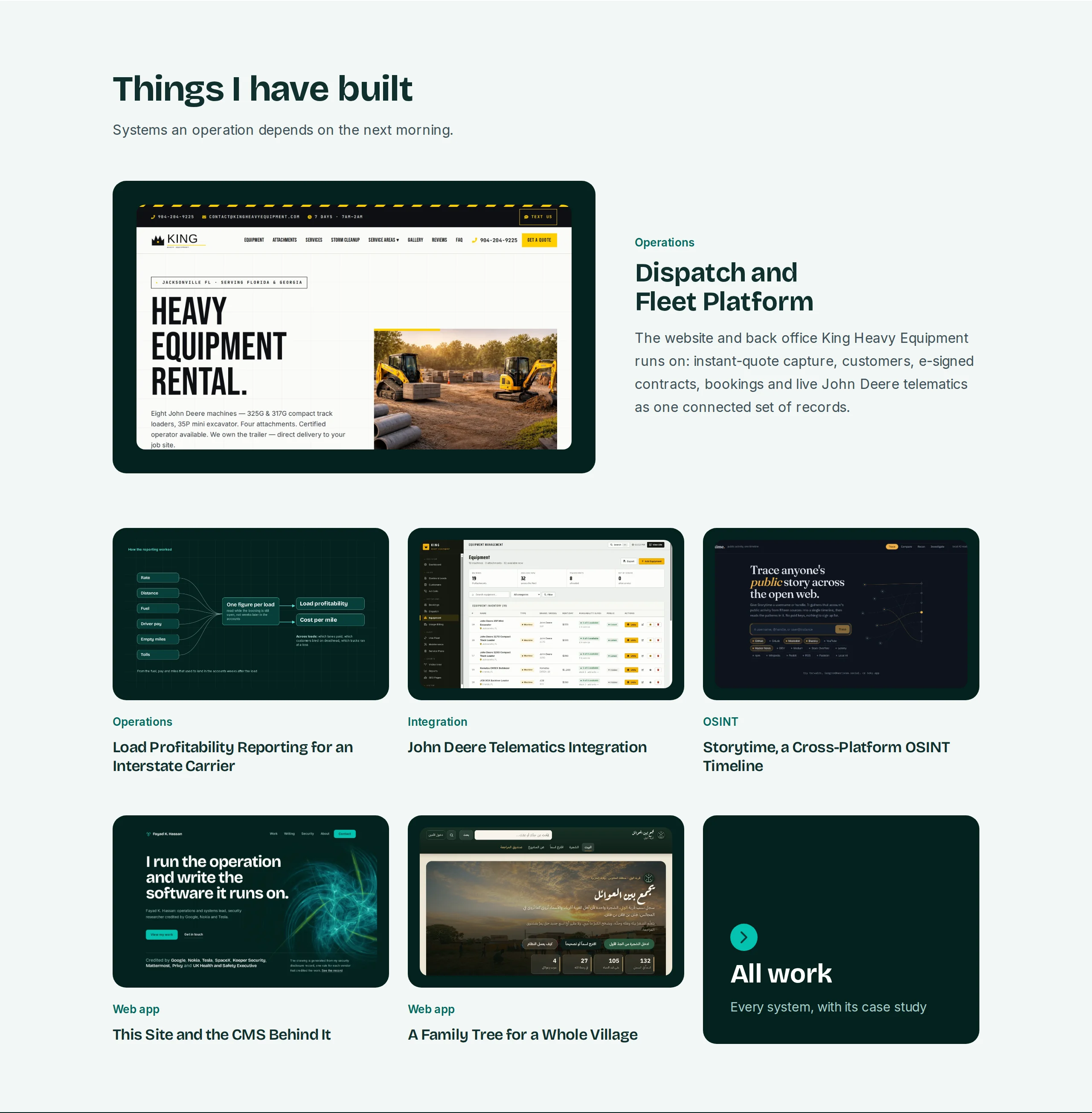
The site you are reading, and the publishing system underneath it. Written from scratch rather than assembled, for the same reason as everything else here.
How it works
Every piece of content is a markdown file with front matter, sitting in a folder. There is no database to back up, migrate or watch fall over under load, and deploying is copying files. The admin side is a bcrypt login with CSRF protection on every action and a rate limit on failed attempts, a markdown editor with image upload, and an editor for each section of the public pages.
The decisions worth defending
No third-party requests. Fonts are self-hosted. The markdown editor is self-hosted and version-pinned rather than pulled from a public CDN, because an unpinned third-party script on the page that holds an admin session is somebody else’s code running with your privileges. The content security policy states the rule and the browser enforces it, so the claim is testable rather than asserted.
It works with JavaScript disabled. One small script folds the menu away on phones, steps the top bar aside while you read, and marks where you are in an essay’s contents. Nothing that matters depends on it: without it the menu shows as links and the contents are plain anchors.
Caching that tells the truth. Assets get a one-year immutable header only where the URL carries a content hash. Everything else gets a short life. An immutable header on a URL that can change is a promise the server cannot keep, and the symptom is a file you replaced that nobody ever sees.
How it’s built
- One token file holds every colour, type size, space, line height and letter-spacing, and a checker fails the build on any literal value anywhere else.
- Six checks run before anything ships: the tokens, a list of banned design habits, contrast (prose at AAA), layout at six widths, third-party requests, and text laid over the artwork, measured from rendered pixels.
- Three typefaces, all self-hosted and cut down to the characters the site uses: Inter, two weights of Bricolage Grotesque, and Source Serif 4 for reading.
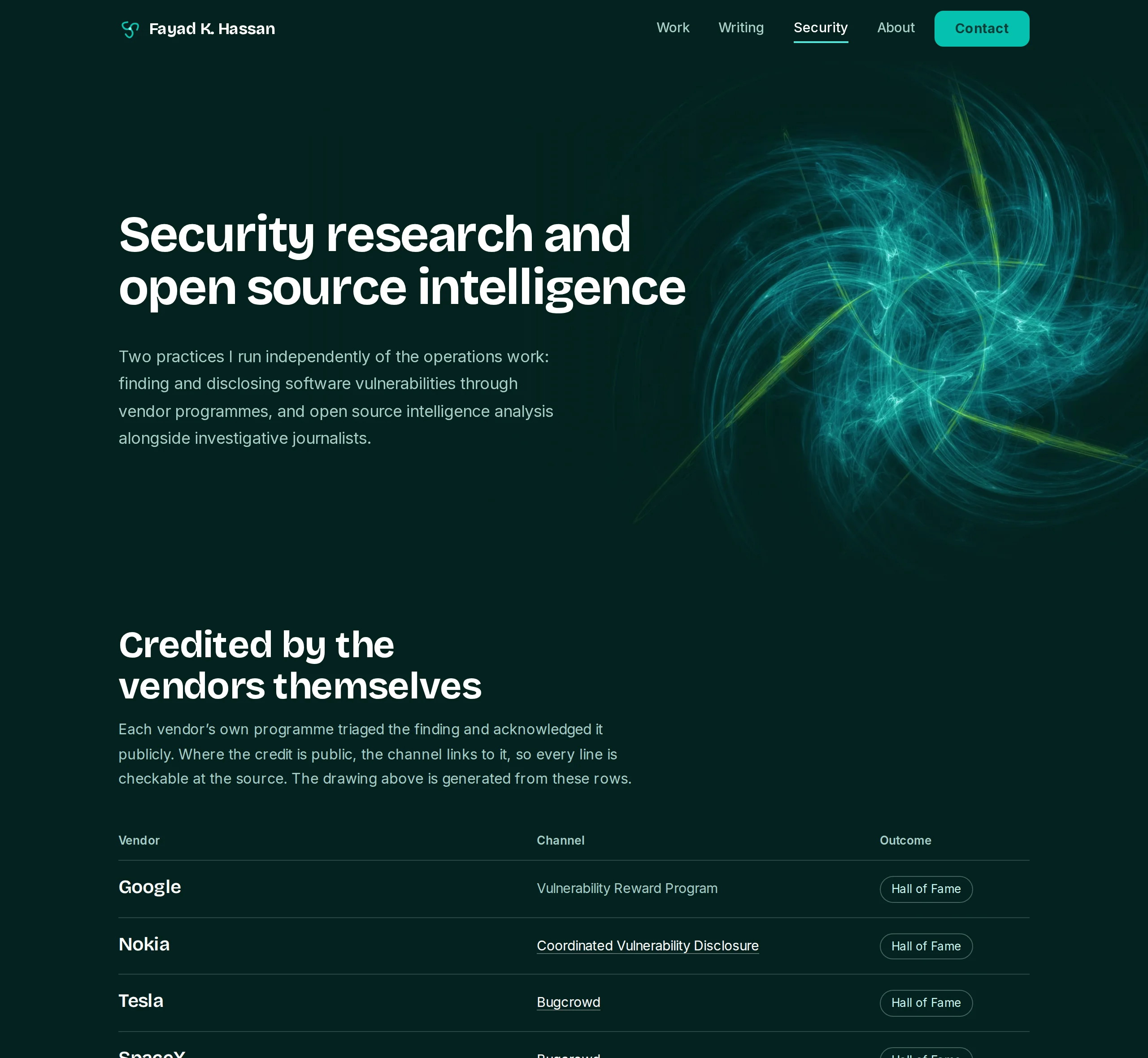
- Every picture is rendered by a script in a real browser with the site’s own fonts: the drawing from the disclosure record, the essay pictures, the diagrams and the share cards.
- A print stylesheet, so an essay or the About page prints without the chrome.
Why build it at all
A personal site is the one system where you are the entire user base, the whole product team and the on-call rotation. It is a rare licence to build the thing properly rather than the thing that ships, and a reasonable place to show how you make engineering decisions when nobody is constraining them.