 Fayad K. Hassan

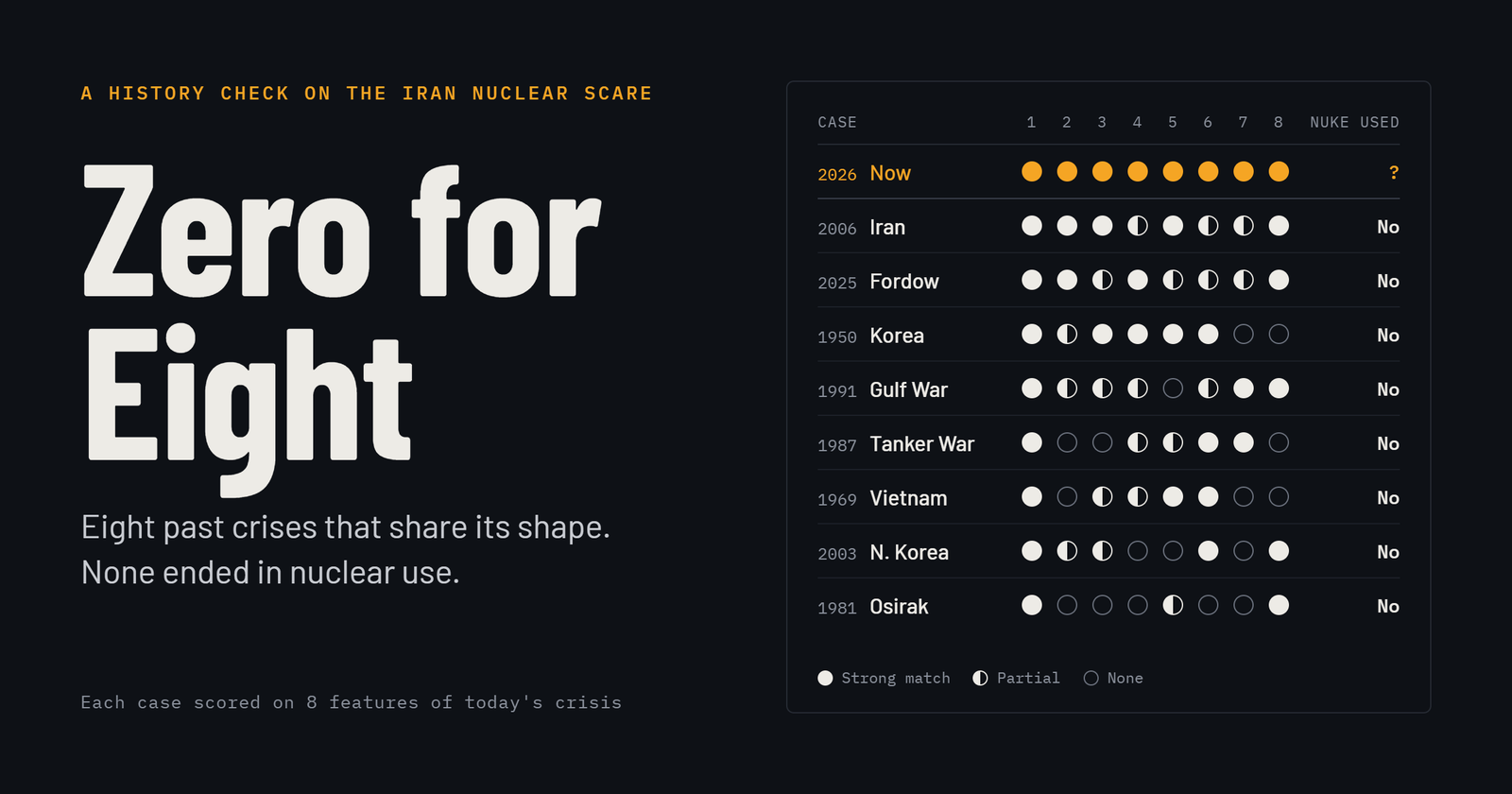
I scored this week’s crisis against eight past standoffs where the bomb was on the table. It was never used. The nuclear risk that does repeat is slower, and it starts with 440 kilograms of uranium nobody outside Iran has seen in more than a year.
On Sunday night, Tucker Carlson posted that the Trump administration “may be within days of launching a nuclear strike on Iran.”[^1] The target, he said, would be Pickaxe Mountain, a tunnel complex next to the Natanz enrichment site that he argued no conventional bomb could reach. He floated November 7 as a decision point. Within a day the post had passed 48 million views.[^2]
The White House replied that Carlson “has no insight into military planning or the Commander-in-Chief’s thinking.”[^3] The official who said it didn’t mention nuclear weapons either way.[^2] Trump told Newsmax in mid-October that he wouldn’t use them, and Carlson has issued versions of this warning several times since April.[^2]
I can’t tell you what the president will decide, and neither can anyone posting about it. What I can do is test the shape of this moment against history, because the shape isn’t new. The last time a famous reporter said a president was weighing nuclear bunker-busters against a buried Iranian enrichment plant was April 2006. That story has an ending. So do several others.
How I built the matrix
I broke the current crisis into eight features:
- A nuclear power fighting a non-nuclear enemy
- A target buried too deep for conventional bombs
- The nuclear option floated in public
- An ally or hawk pushing for escalation
- Voters punishing the war
- Talks running alongside the fighting
- An oil or shipping shock
- The enemy edging toward a bomb
Right now the US-Iran war hits all eight. It began with US and Israeli strikes on February 28 and has since been through an April ceasefire, a signed memorandum in June, and a collapse in July.[^4] Attacks on tankers around Hormuz reached their highest level of the war in October and pushed oil back above $100 a barrel.[^5] On Tuesday, voters gave Democrats both chambers of Congress, and Vice President JD Vance said the war was the reason Republicans lost.[^6]
I then scored eight past crises on the same features: 2 for a strong match, 1 for a partial one, 0 for none. A perfect match is 16.
| Case | 1 | 2 | 3 | 4 | 5 | 6 | 7 | 8 | Score | What happened |
|---|---|---|---|---|---|---|---|---|---|---|
| Now (Nov 2026) | ● | ● | ● | ● | ● | ● | ● | ● | 16 | Still unfolding |
| Iran, 2006 | ● | ● | ● | ◐ | ● | ◐ | ◐ | ● | 13 | Nuclear option leaked, denied, dropped. No strike. |
| Fordow, 2025 | ● | ● | ◐ | ● | ◐ | ◐ | ◐ | ● | 12 | Conventional bombs. Ceasefire two days later. |
| Korea, 1950-53 | ● | ◐ | ● | ● | ● | ● | ○ | ○ | 11 | Bomb floated, not used. Armistice in 1953. |
| Gulf War, 1991 | ● | ◐ | ◐ | ◐ | ○ | ◐ | ● | ● | 10 | Veiled nuclear warning. Over in six weeks. |
| Tanker War, 1987-88 | ● | ○ | ○ | ◐ | ◐ | ● | ● | ○ | 8 | US strikes, then Iran accepted a ceasefire. |
| Vietnam, 1969-73 | ● | ○ | ◐ | ◐ | ● | ● | ○ | ○ | 8 | Nuclear plan shelved. Bombing blitz, then a deal. |
| North Korea, 2003 | ● | ◐ | ◐ | ○ | ○ | ● | ○ | ● | 8 | Left the NPT. Tested a bomb in 2006. |
| Osirak, 1981 | ● | ○ | ○ | ○ | ◐ | ○ | ○ | ● | 5 | Reactor destroyed. Iraq went covert for a bomb. |
● strong match · ◐ partial · ○ none
The scores are my judgment, and you could argue a point here or there. What you can’t do is make the last column say “nuclear weapon used.” It doesn’t, for any of them.
Four patterns came out of it. The first three are about the next few weeks. The fourth is about the next few years, and it’s the one I’d worry about.
1. The nuclear rumor is the most common feature and the worst predictor
On November 30, 1950, with Chinese armies driving UN forces back in Korea, a reporter asked Truman whether the atomic bomb was under consideration. “There has always been active consideration of its use,” he answered.[^7] The White House issued a clarification that same day,[^7] and British prime minister Clement Attlee announced he was flying to Washington, partly to give Truman his views on the bomb.[^8] It wasn’t used. The war dragged on until an armistice in July 1953, with most of that time spent fighting and negotiating at once.
In 1969, Nixon’s planners drafted an escalation package for Vietnam, later known as Duck Hook, that included options for tactical nuclear strikes.[^9] Nixon shelved it that fall and ordered a secret worldwide nuclear alert instead, hoping Moscow and Hanoi would conclude he was reckless enough to go further.[^9] On October 27, nuclear-armed B-52s flew a “show of force” over Alaska.[^10] Hanoi didn’t budge, and American involvement in the war lasted more than three more years.
In April 2006, Seymour Hersh reported in The New Yorker that Pentagon contingency plans for Iran included a nuclear bunker-buster, the B61-11, against underground sites such as the centrifuge plant at Natanz. According to his sources, some military chiefs had tried and failed to get the nuclear option removed.[^11] Bush dismissed the reporting as “wild speculation.”[^12] Later that year, Hersh reported that the nuclear option had been dropped because of Pentagon opposition, and that the Air Force had proposed a substitute: large conventional bunker-busters dropped in quick succession.[^13]
Nineteen years later, that is close to what happened. In June 2025, as planners again argued over whether only a nuclear weapon could destroy a deeply buried site, this time Fordow,[^14] B-2s dropped 14 conventional GBU-57 bombs on Fordow and Natanz.[^15] A ceasefire took effect two days later.[^16]
The nuclear option was floated, at least partly, in six of my eight cases. It was used in none. The rumor measures how frightening a crisis feels. So far it has said nothing about how one ends.
What stopped it each time wasn’t public opinion. In a 2015 survey experiment, Scott Sagan of Stanford and Benjamin Valentino of Dartmouth found that 56% of Americans preferred a nuclear strike on an Iranian city that would kill 100,000 civilians over a ground invasion expected to kill 20,000 US soldiers.[^17] In another version, about 60% approved of a strike killing 2 million Iranian civilians.[^18] The brakes were somewhere else: an ally on a plane in 1950, doubts in 1969 about whether escalation would even work, generals pushing back in 2006, and a conventional alternative good enough to use instead.
Those brakes still exist. In June 2025, while Israel and then the US were striking Iran, UMass Amherst’s Human Security Lab asked current and former US service members whether they would follow an order that ended in a nuclear strike on a civilian city. Only 44% said they would, and 42% said they would refuse. Support among them for the president’s sole authority over nuclear launch fell 10 points while the crisis unfolded.[^19]
The physics hasn’t changed either. Newsweek’s reporting puts the heart of Pickaxe Mountain as much as 100 meters underground, deep enough that even the largest US conventional bombs would be hard-pressed to destroy it, and still describes any nuclear strike as very unlikely.[^15] A 2005 National Academies study for Congress concluded that a burrowing nuclear warhead can’t get deep enough to contain its explosion, and put deaths from such attacks anywhere from thousands to more than a million depending on the target.[^20]
2. Losing an election over a war rarely ends it quickly
On November 7, 2006, Republicans lost both houses of Congress, with Iraq at the center of the campaign. Until this week, that was the last time a Republican president had lost both chambers.[^21] Bush announced Rumsfeld’s departure the next day.[^22] He did not announce a withdrawal. Within weeks he was weighing a troop increase, which he unveiled in January as the surge.[^23]
Nixon offers the sharper version. In October 1972, Kissinger had declared that “peace is at hand.”[^24] Nixon knew that once the new Congress met in January, it could cut off war funding.[^25] When the Paris talks stalled in December, he ordered Linebacker II, eleven days of heavy B-52 raids on North Vietnam from December 18 to 29. The Paris Peace Accords were signed on January 27, 1973, on terms close to the October draft.[^24] At the end of June, Congress passed the Case-Church amendment cutting off funds for further US combat in Southeast Asia, and Nixon signed it on July 1.[^26]
Now line that up with this week. Democrats won both chambers on Tuesday, but the new Congress isn’t sworn in until January 3. Trump has accepted that the war probably cost his party the election and said he would make the same decision again.[^27] Netanyahu reportedly pressed for US strikes to resume right after the vote, while Trump said there was no great rush.[^28] He has also said the US could hit Pickaxe Mountain within an hour if it had to.[^29]
In both precedents, the president tried one more forceful move before conceding anything. If that happens again, the weeks before January are where it’s most likely to fall.
3. Shipping wars with Iran end when Tehran decides the price is too high
On April 14, 1988, the frigate USS Samuel B. Roberts struck an Iranian mine in the Gulf that nearly ripped it in half.[^30] Four days later, in Operation Praying Mantis, US forces destroyed two Iranian platforms, sank two Iranian ships and badly damaged a third.[^31] The UN ceasefire resolution had been on the table since July 1987, and Iran had rejected it for almost a year.[^32] In July 1988 it accepted. Khomeini likened the decision to swallowing poison.[^33]
The tanker war scores only an 8 because nobody was talking about nuclear weapons. On the narrower question of how the Hormuz fighting ends, though, it’s the closest precedent I have: mines, burning tankers, US strikes on Iranian assets, and finally a ceasefire Tehran had sworn it would never accept.
The big difference is who decides in Tehran. In 1988 it was one man. Today the new supreme leader, Mojtaba Khamenei, has said he sees the June memorandum differently from President Masoud Pezeshkian,[^34] while Pezeshkian says he has now been given more authority to pursue peace talks.[^29] Iran’s foreign minister has reportedly urged the security leadership to move on the latest Qatari proposal,[^35] and its chief negotiator, Mohammad Bagher Ghalibaf, read the US midterms as a vote against the war.[^27]
4. The repeat that actually worries me
The most reliable nuclear pattern in the table plays out years after the bombing stops.
When Israel destroyed Iraq’s Osirak reactor in 1981, the strike was celebrated as a model of prevention. Later research using Iraqi sources, by Målfrid Braut-Hegghammer, concluded it “triggered a covert nuclear weapons program that did not previously exist.”[^36] Three months after the raid, Saddam set up a well-funded clandestine weapons program outside the IAEA’s view, and nine years later Iraq was close to a bomb.[^37] By political scientist Dan Reiter’s count, the effort grew from roughly 400 scientists and $400 million to 7,000 scientists and $10 billion.[^38]
North Korea announced its withdrawal from the NPT on January 10, 2003,[^39] and carried out its first nuclear test on October 9, 2006.[^40] When Western air strikes on Libya began in 2011, Pyongyang held up Libya’s decision to give up its weapons program as a lesson for the world.[^41]
Iran is now making the same kinds of moves. A bill to leave the NPT sits before parliament, and senior officials say Iran is weighing a change to its doctrine against nuclear weapons.[^42] The foreign ministry has ruled out moving its enriched uranium abroad,[^43] and Mohsen Rezaei, a senior security official, said “not a single gram” would leave the country.[^44] Before the strikes of June 2025, the IAEA counted 440.9 kilograms of uranium enriched to 60%.[^45] The agency believes much of it sits in tunnels at Isfahan but says it can’t establish how much is there or exactly where.[^46] Analysts in Washington now argue that eight months of war have made Tehran more inclined to seek a bomb as a deterrent.[^44]
The good news is time. With its enrichment plants destroyed or sealed, Iran is estimated to need a year or more to build a weapon even if it decided to, and the US Director of National Intelligence testified in March that it hadn’t tried to rebuild its enrichment capability since the 2025 strikes.[^47] On the historical evidence, the serious nuclear risk sits somewhere around 2027 to 2029. The same evidence suggests that destroying Pickaxe Mountain, by whatever means, wouldn’t settle it.
My odds
These are my own judgment calls, built from the patterns above, for the roughly ten weeks until the new Congress sits.
| Scenario | Odds | Closest precedent |
|---|---|---|
| A big conventional strike, then a hard push for a deal | 35% | Linebacker II (1972), Praying Mantis (1988), Fordow (2025) |
| Grinding stalemate: talks plus sporadic strikes, Hormuz contested | 35% | Korea (1951-53) |
| A deal without a major new strike | 20% | The June 2026 memorandum |
| A wider regional war | 9% | None of the eight |
| Nuclear use by anyone | About 1% | None of the eight |
Over a longer horizon, I’d put the chance that Iran makes a serious attempt at a weapon before 2030 at about one in three. That’s the number I’d pay the most attention to.
What would change my mind
- A chemical weapons incident. Israel has reportedly told Washington that Iran is considering chemical weapons if fighting resumes, though some US officials are skeptical and see the claim as pressure to escalate.[^35] It matters because 1991 is the one case on my list where a US threat was widely read as nuclear. Before the Gulf War, James Baker warned Iraq’s foreign minister that using chemical or biological weapons would bring a devastating response. Iraqi officials later told UN inspectors they held back because they assumed that meant nuclear retaliation.[^48] Baker has said he doesn’t know whether Bush would actually have gone nuclear.[^49] If chemical weapons are used, my 1% goes up.
- Movement rather than words. Evacuations of US diplomats or bases near Iran, or credible reports of nuclear-capable bombers moving into position, would tell me more than any post on X.
- Confirmed enrichment at Pickaxe. Israeli intelligence has indicated that Iran moved centrifuges there,[^50] Iran denies any nuclear work at the site,[^2] and UN inspectors have never been inside.[^51] Confirmation would sharpen exactly the dilemma that produced every nuclear rumor in my table.
- An actual NPT vote. If Iran’s parliament passes the withdrawal bill, the North Korea row becomes the one to watch.
Where this could be wrong
Eight cases is a small sample, and I chose them. A different set might include the Cuban Missile Crisis, which ended without a shot but came closer to nuclear war than anything here. This matrix also leaves out Russia, which has warned NATO it would use nuclear weapons if the alliance tried to cut off Kaliningrad.[^52] That’s a separate crisis that needs its own table, and it involves an adversary that can shoot back.
Every brake described above depends on people: allies who object, officers who refuse, a conventional option good enough to use instead. People and institutions change under pressure.
The deepest limit is built into the method. History tells you what usually happens. It can’t see a genuine first. In August 1945 there was no precedent for using an atomic bomb either, and any method built on the eighty years since will score nuclear use close to zero. That’s why I’d keep the 1% and not round it down.
If you want to know whether a nuclear weapon goes off over Iran this month, watch the Pentagon and the chain of command, not the posts. If you want to know whether Iran has one by the end of the decade, watch what happens to 440 kilograms of uranium that nobody outside Iran has seen since June 2025.
Sources
[^1]: Mediaite, “Tucker Carlson Warns Netanyahu Is Goading Trump to Nuke Iran: ‘The Only Military Option’,” November 2026. https://www.mediaite.com/media/news/tucker-carlson-warns-netanyahu-is-goading-trump-to-nuke-iran-the-only-military-option/
[^2]: International Business Times UK, “White House Won’t Rule Out Any Option After Tucker Carlson Claims Trump Is Days From a Nuclear Strike on Iran,” November 2026. https://www.ibtimes.co.uk/white-house-tucker-carlson-nuclear-strike-iran-claim-1829739
[^3]: The War Zone, “A Nuclear Strike On Iran? It Sounds Absurd Because It Is. Let’s Talk About It,” November 2026. https://www.twz.com/nuclear/a-nuclear-strike-on-iran-it-sounds-absurd-because-it-is-lets-talk-about-it
[^4]: Congressional Research Service, “U.S. Conflict with Iran,” R48887. https://www.congress.gov/crs-product/R48887
[^5]: Ara, “Attack against an oil tanker in Qatar after Iran threatens to close crude oil transit through Hormuz,” October 2026. https://en.ara.cat/international/attack-against-an-oil-tanker-in-qatar-after-iran-threatens-to-close-crude-oil-transit-through-hormuz_1_5873138.html
[^6]: Fox News, “Trump insists Iran war was necessary after historic midterm losses for GOP,” live coverage, November 4, 2026. https://www.foxnews.com/live-news/iran-war-news-trump-elections-oil-prices-november-4
[^7]: Foreign Relations of the United States, 1950, Vol. I, Document 43, on Truman’s press conference of November 30, 1950, and the White House statement that followed. https://history.state.gov/historicaldocuments/frus1950v01/d43
[^8]: The Michigan Daily, front page, December 1, 1950, on Attlee’s planned meeting with Truman. https://digital.bentley.umich.edu/midaily/mdp.39015071756287/417
[^9]: National Security Archive, “Nixon’s Nuclear Specter: The Secret Alert of 1969, Madman Diplomacy, and the Vietnam War.” https://nsarchive.gwu.edu/node/4176
[^10]: William Burr and Jeffrey Kimball, Bulletin of the Atomic Scientists 59, no. 1 (2003), on the October 1969 “Giant Lance” alert. https://journals.sagepub.com/doi/10.2968/059001011
[^11]: The Telegraph, “Bush ‘is planning nuclear strikes on Iran’s secret sites’,” April 9, 2006, via GlobalSecurity.org. https://www.globalsecurity.org/org/news/2006/060409-nuclear-strikes-iran.htm
[^12]: Democracy Now!, interview with Seymour Hersh, April 12, 2006, including Bush’s response. https://democracynow.org/2006/4/12/seymour_hersh_bush_administration_planning_possible
[^13]: Scoop, report on Hersh’s follow-up that the nuclear option was dropped at the insistence of the chiefs, August 2006. https://m.scoop.co.nz/stories/HL0608/S00113/nuke-iran-idea-dropped-at-insistence-of-chiefs.htm
[^14]: The Times of Israel (blogs), “The Nuclear Option for Pickaxe Mountain,” 2026. https://blogs.timesofisrael.com/the-nuclear-option-for-pickaxe-mountain/
[^15]: Newsweek, “What a US Nuclear Strike on Iran’s Pickaxe Mountain Could Look Like,” November 2026. https://www.newsweek.com/what-a-us-nuclear-strike-on-irans-pickaxe-mountain-could-look-like-12656972
[^16]: Wikipedia, “Twelve-Day War ceasefire.” https://en.wikipedia.org/wiki/Twelve-Day_War_ceasefire
[^17]: Scott D. Sagan and Benjamin A. Valentino, “Does the Noncombatant Immunity Norm Have Stopping Power? A Debate,” Stanford REAP, summarizing the survey published as “Revisiting Hiroshima in Iran,” International Security 42, no. 1 (2017). https://reap.fsi.stanford.edu/node/29082
[^18]: Phys.org, Stanford news release on Sagan and Valentino’s findings, August 2017. https://phys.org/news/2017-08-opinion-curb-nuclear-weapons-war.pdf
[^19]: University of Massachusetts Amherst, “As Iran Crisis Unfolded, Military-Trained Americans’ Support of President’s Sole Authority on Nuclear Weapons Dropped in Real Time,” 2025. https://www.umass.edu/news/article/iran-crisis-unfolded-military-trained-americans-support-presidents-sole-authority
[^20]: National Research Council, Effects of Nuclear Earth-Penetrator and Other Weapons (Washington, DC: National Academies Press, 2005).
[^21]: Al Jazeera, “Democrats win control of House and Senate: Key US midterms takeaways,” November 4, 2026. https://www.aljazeera.com/news/2026/11/4/democrats-win-control-of-house-and-senate-key-us-midterms-takeaways
[^22]: Government Executive, “Bush announces Rumsfeld resignation,” November 2006. https://govexec.com/defense/2006/11/bush-announces-rumsfeld-resignation/23088
[^23]: Fox News, “Iraq, Elections Topped Political News of 2006,” December 2006. https://www.foxnews.com/story/iraq-elections-topped-political-news-of-2006
[^24]: Wikipedia, “Operation Linebacker II.” https://en.wikipedia.org/wiki/Operation_Linebacker_II
[^25]: “The 11 Days of Xmas: The December 1972 USAF Strategic Air Command Campaign Against Hanoi,” INISEG military history paper. https://ciia-historia-militar.iniseg.es/administracion/public/uploads/adjuntos/the-11-days-of-xmas-the-december-1972-usaf-strategic-air-command-campaign-against-hanoi.pdf
[^26]: Wikipedia, “Case–Church Amendment.” https://en.wikipedia.org/wiki/Case%E2%80%93Church_Amendment
[^27]: Gulf News, “Middle East conflict: Trump warns of ‘heavy hit’ as Iran says Americans voted ‘no to war’,” November 4, 2026. https://gulfnews.com/world/mena/middle-east-conflict-trump-warns-of-heavy-hit-as-iran-says-americans-voted-no-to-war-1.500735100
[^28]: JINSA, “Iran War Update: October 31–November 2, 2026,” citing Axios. https://jinsa.org/wp-content/uploads/2026/11/Iran-War-Update-11.2.26.pdf
[^29]: Foundation for Defense of Democracies, Overnight Brief, November 3, 2026. https://www.fdd.org/overnight-brief/november-3-2026/
[^30]: GlobalSecurity.org, “Operation Praying Mantis.” https://www.globalsecurity.org/military/ops/praying_mantis.htm
[^31]: Naval History and Heritage Command, “Operation Praying Mantis.” https://www.history.navy.mil/browse-by-topic/wars-conflicts-and-operations/middle-east/praying-mantis.html
[^32]: Radio Farda, on Khamenei’s remarks about Resolution 598. https://en.radiofarda.com/a/30852269.html
[^33]: The Christian Science Monitor, “Iran bows to pragmatism in opting to make peace,” July 22, 1988. https://www.csmonitor.com/1988/0722/onico.html
[^34]: House of Commons Library, “US-Iran ceasefire and nuclear talks in 2026.” https://commonslibrary.parliament.uk/research-briefings/cbp-10637/
[^35]: JINSA, “Iran War Update: November 3–4, 2026,” citing The New York Times. https://jinsa.org/wp-content/uploads/2026/11/Iran-War-Update-11.4.26.pdf
[^36]: Målfrid Braut-Hegghammer, “Revisiting Osirak: Preventive Attacks and Nuclear Proliferation Risks,” International Security 36, no. 1 (2011), abstract via the Belfer Center. https://www.belfercenter.org/publication/revisiting-osirak-preventive-attacks-and-nuclear-proliferation-risks
[^37]: Dawn, on the Osirak strike and its aftermath, 2012. https://www.dawn.com/news/705745
[^38]: Dan Reiter, “Preventive Attacks Against Nuclear Programs and the ‘Success’ at Osiraq,” Nonproliferation Review 12, no. 2 (2005).
[^39]: International Atomic Energy Agency, on the DPRK’s January 2003 withdrawal from the NPT. https://www.iaea.org/node/5970
[^40]: New Zealand Herald, Reuters timeline of the North Korea nuclear crisis. https://nzherald.co.nz/world/timeline-north-korea-nuclear-crisis/YSXMZAYWWLOTNSRSKQG77RVS7M
[^41]: PRI, “North Korea: Libya should have kept nuclear weapons program,” March 25, 2011. https://www.pri.org/stories/2011-03-25/north-korea-libya-should-have-kept-nuclear-weapons-program
[^42]: GlobalSecurity.org, “Iran War 2026: Day 247 Update,” November 1, 2026. https://www.globalsecurity.org/military/ops/iran-war-oprep.htm
[^43]: The Jewish Chronicle, “Iran rules out removal of enriched uranium amid fresh threat of US strikes,” November 2, 2026. https://www.thejc.com/news/world/iran-rules-out-removal-of-enriched-uranium-amid-fresh-threat-of-us-strikes-m4kvnc8a
[^44]: The Christian Science Monitor, “Does Tehran want the bomb? Some in DC say war has shifted Iran’s thinking,” November 2, 2026. https://www.csmonitor.com/USA/Foreign-Policy/2026/1102/iran-regime-survival-nuclear-policy-bomb
[^45]: IAEA Board of Governors, report GOV/2026/8, February 27, 2026. https://www.iaea.org/sites/default/files/gov2026-8.pdf
[^46]: Next Century Foundation, “A Nuclear Iran,” November 4, 2026. https://www.nextcenturyfoundation.org/a-nuclear-iran/
[^47]: GlobalMilitary.net, “Iran’s nuclear program.” https://www.globalmilitary.net/nuclear/irn/
[^48]: R. Jeffrey Smith, The Washington Post, “Iraq Says It Was Poised To Use Biological, Chemical Weapons,” August 1995, via The Spokesman-Review. https://www.spokesman.com/stories/1995/aug/26/iraq-says-it-was-poised-to-use-biological
[^49]: PBS Frontline, interview with James Baker. https://www.pbs.org/wgbh/pages/frontline/shows/plague/interviews/baker.html
[^50]: Denver Gazette, “Trump promises Pickaxe Mountain strike could happen ‘very soon’.” https://www.denvergazette.com/?p=566251
[^51]: Telangana Today, “Explainer: What to know about Iran’s Pickaxe Mountain,” November 3, 2026. https://telanganatoday.com/explainer-what-to-know-about-irans-pickaxe-mountain
[^52]: Arms Control Association, “Russia Issues Nuclear Threats Over Kaliningrad,” Arms Control Today, November 2026. https://www.armscontrol.org/act/2026-11/news/russia-issues-nuclear-threats-over-kaliningrad
 Fayad K. Hassan